|
About King's Visualisation Lab
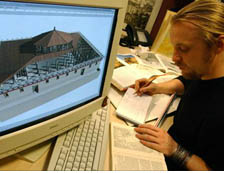 King's Visualisation Lab (KVL) is part of the Department of Digital Humanities (DDH) an international leader in the application of digital technologies to research in the arts, humanities and social sciences. King's Visualisation Lab (KVL) is part of the Department of Digital Humanities (DDH) an international leader in the application of digital technologies to research in the arts, humanities and social sciences.
Beginning in 1996, under the direction of Prof. Richard Beacham, KVL members have worked on a series of research projects and heritage visualisation commissions, modelling historic spaces; collecting, collating and presenting associated datasets; and developing sophisticated user-interfaces for accessing, manipulating, and investigating research results.
KVL, which has completed projects for numerous organisations including the Royal Botanical Gardens at Kew and the Royal Shakespeare Theatre, is currently creating a research-based model of the Roman Villa at Boscoreale for the Metropolitan Museum of Art, New York.
Funded by the Leverhulme Trust, the KVL team undertook the Skenographia project on the theatricality of ancient Roman domestic space and décor, and now holds a major new grant from the Leverhulme Trust to work with Prof. John Clarke, University of Texas at Austin, and the Archaeological Superintendency of Pompeii on a NEH-funded project to create the first, comprehensive scientific publication of the Roman Villa at Oplontis. KVL, in collaboration with the Department of Classics and Ancient History at the University of Durham, also lead an AHRC-funded investigation of The Body and Mask in Ancient Theatre Space.
KVL’s activities in Virtual Worlds include the Eduserv-funded THEATRON 3 project, which is creating annotated research models of 25 historic theatres in Second Life, together with a host of innovative research and educational tools. (See also the EU-funded THEATRON project.)
The team also worked on the Leverhulme- and AHRB-funded Pompey Project, an extensive programme of research, led by Prof. James Packer, Northwestern University, into the city of Rome's first stone theatre. Today, KVL is conducting significant, original research on the Odeion of Agrippa at Athens and, with Frank Sear, University of Melbourne, on the Archaeology of the Small and Large Theatres at Pompeii.
With artist-in-residence, Michael Takeo Magruder, King's Visualisation Lab develops online 3d technologies for the creation of New Media Art and is involved in developing exciting new intersections between humanities research and contemporary arts practice, including “Arts and Humanities Intersections” works such as the Vitruvian World and Rhythmic Spaces.
KVL hosts 3DVisA: a national network funded by the JISC supporting academics in the arts and humanities the use of digital visualisation and is centrally involved in the London Charter initiative, which is developing internationally-recognised standards for the use of computer-based visualisation in cultural heritage.
In collaboration with the University of Pisa, KVL curates Digital Humanities Island in Second Life and, funded by the British Council and the Italian Ministry of Research and Higher Education, carries out research into heritage visualisation in Virtual Worlds.
| KVL core team: |
|
|
| Past members: |
|
| |
- Prof. Richard Beacham (Founding Director 1996-2011)
- Marco Bani (Oplontis Project Reseach Fellow 2008-2010)
- Dr. Julie Tolmi (3DVisA Development Officer 2006-2008)
- Dr. Christa Williford (Research Fellow 1998-2004)
|
|
| Internships: |
|
| |
- Mawo Kamakura (International internship from the University of Tokyo, Japan. May-July 2010)
- Fabio Renzoni (Erasmus internship from the University of Pisa, Italy. July 2010)
- Dr. Woong Choi (International internship from Ritsumeikan University, Kusatsu, Japan. April-July 2009)
- Francesco Orsi (Erasmus internship from the University of Pisa, Italy. March-April 2009)
- Fabrizio Giannone (Erasmus internship from the University of Bologna, Italy. June-August 2008)
|
|
|
|
